

16 Jul 2026
Cable TDS, Material Norms and Technology: Where the Extra Copper Goes
The design says 68.3 kg of copper per km and the order used 73.7. See how a cable TDS turns into kg/km material norms, why start-up scrap makes short orders expensive, and what a technology card holds.
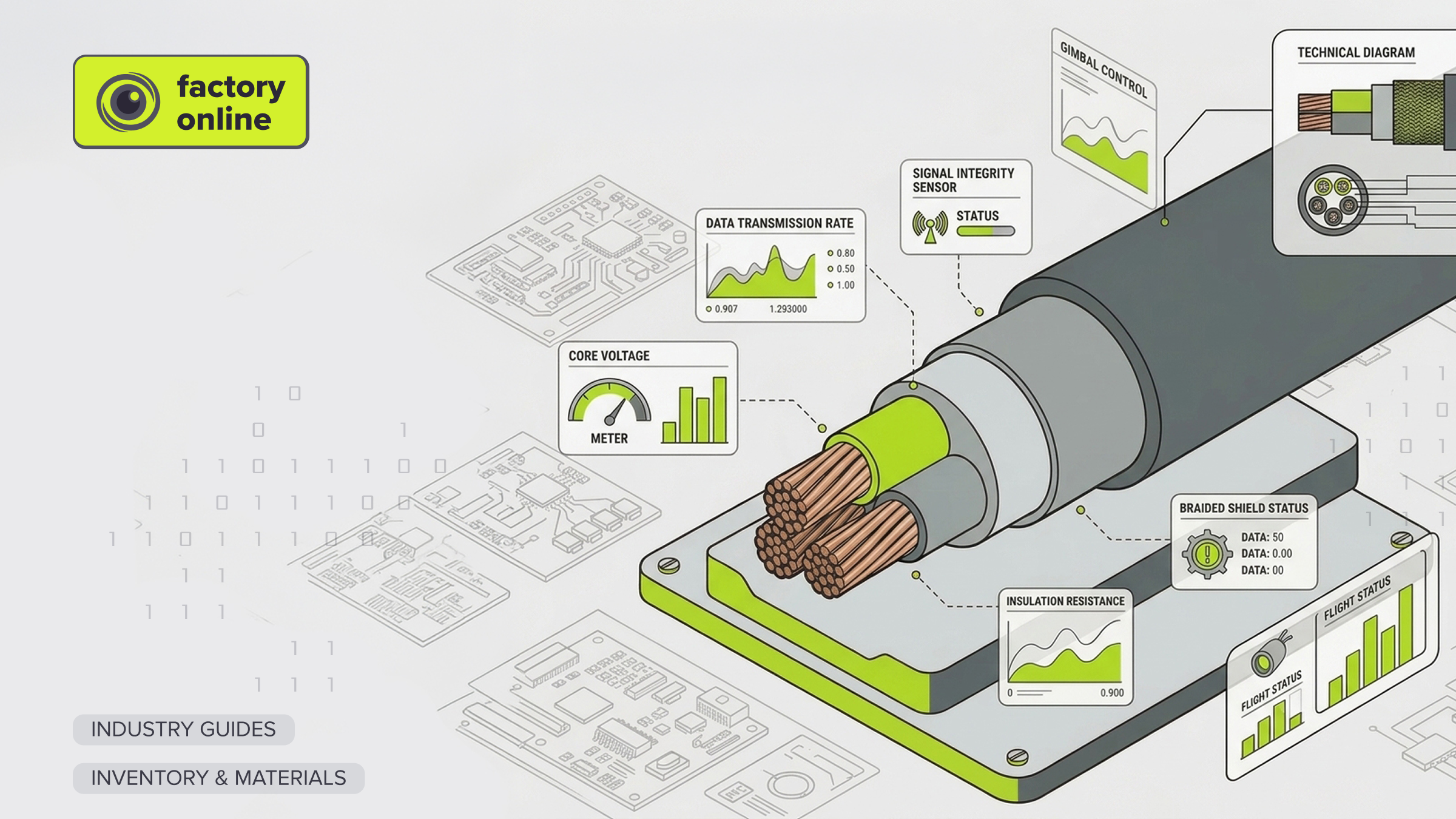
A customer orders 5 km of a 3 × 2.5 mm² power cable. The design says 68.3 kg of copper per kilometer, so the planner books 342 kg. The order finishes with 369 kg consumed and nobody stole anything. The difference sits in a part of the material norm that most spreadsheets don't have: the fixed scrap each line throws away every time it starts.
In cable manufacturing, three documents describe the same product. The TDS (technical data sheet) is what the customer is promised: construction, dimensions, electrical values, the standard. The material norms say how much copper, insulation and sheath go into one kilometer. The process technology (the technology card) says how each line makes it: operations, speeds, temperatures, lay lengths, tests. Together they are the cable plant's bill of materials and routing.
The TDS: what the customer is promised
Our example is a 3 × 2.5 mm², 0.6/1 kV cable, PVC insulated and PVC sheathed, built to IEC 60502-1. The key lines of its TDS:
- Conductor: plain copper, class 2 stranded, 7 wires
- Max. conductor resistance at 20 °C: 7.41 Ω/km
- Insulation: PVC, nominal thickness 0.8 mm, cores colored brown, black, grey
- Sheath: PVC, nominal thickness 1.8 mm, black
- Outer diameter: about 11.4 mm
- Routine voltage test: 3.5 kV AC, 5 minutes
A TDS is written in values the customer can test. It doesn't say how many kilograms of anything go in. That's the plant's job.
Myth: "2.5 mm² means 2.5 mm² of copper"
It doesn't. The nominal cross-section is defined by resistance, not geometry. Our conductor uses 7 wires of 0.67 mm: 7 × π/4 × 0.67² = 2.468 mm² of copper. Its resistance works out to about 7.13 Ω/km, comfortably under the 7.41 limit, so it passes as 2.5 mm². Designing to resistance instead of the nominal area saves copper on every kilometer, and at copper prices that adds up fast.
Material norms: from design to kg/km
There's a handy rule in cable design: area in mm² × density in g/cm³ = kg per km. Here's the norm for one kilometer of finished cable:
Copper. 2.468 mm² × 8.89 g/cm³ = 21.94 kg per km of conductor. The six outer wires are twisted around the center one, so each is about 2% longer than the conductor. That adds 1.7%: 22.32 kg per km of core. Laying up three cores adds another 2% of core length (3 × 1.02 = 3.06 km of core per km of cable), so copper is 22.32 × 3.06 = 68.3 kg/km.
Insulation. The core goes from 2.01 mm to 3.61 mm diameter. The ring area is π/4 × (3.61² − 2.01²) = 7.06 mm². With PVC at 1.45 g/cm³, that's 10.24 kg per km of core, and × 3.06 = 31.3 kg/km of cable.
Sheath. Three cores laid up measure about 7.78 mm across; with 1.8 mm of sheath the cable is 11.38 mm. The sheath also fills the gaps between cores, so its area is the full circle minus the three cores: π/4 × (11.38² − 3 × 3.61²) = 71.0 mm². At 1.50 g/cm³, that's 106.5 kg/km.
Total: about 206 kg per kilometer, in line with typical published weights for this cable type.
The part of the norm that isn't per kilometer
Every line wastes a fixed length each time it starts: the cable made while the extruder settles, the diameter is dialed in, and the first spark test passes. For this plant:
- insulation line: 150 m of core per color
- laying-up machine: 50 m of cable
- sheathing line: 200 m of cable
For the 5 km order, working backward: sheathing 5,000 + 200 = 5,200 m. Laying up 5,200 + 50 = 5,250 m. Core per color 5,250 × 1.02 + 150 = 5,505 m, three colors = 16,515 m of core.
Copper consumed: 16.515 km × 22.32 kg = 368.6 kg, or 73.7 kg per km of finished cable. That's 8% above the design norm. For a 20 km order the same fixed scrap is spread thinner: 1,393 kg of copper, 69.6 kg/km, just 2% over. So a norm has two parts, a per-km part and a per-run part, and the order length decides which one hurts. This is also why short orders are expensive in cable manufacturing planning.
Process technology: how each line makes it
The technology card follows the cable through the plant:
- Wire drawing: 8 mm copper rod drawn down to 0.67 mm, then annealed so it's soft enough to strand.
- Stranding: 7 wires into a class 2 conductor, with a set lay length.
- Insulation: PVC extruded to 0.8 mm at about 600 m/min, one color per run, with an in-line spark test.
- Laying up: three cores twisted together at about 60 m/min.
- Sheathing: PVC extruded to 1.8 mm at about 50 m/min, with the meter marking printed on.
- Testing and drumming: conductor resistance, 3.5 kV voltage test, cut to 1,000 m lengths on five drums.
The card also holds the extruder temperature profile, the die sizes and the lay lengths, because they decide whether the TDS values come out right. Line speed decides time: sheathing 5,200 m at 50 m/min is 104 minutes of machine time. And the finished lengths have to fit the drums you actually have.
How this looks in factory.online
In factory.online, each cable design carries its own material norms per kilometer and its own operations, and the insulated core per color is its own semi-finished item. MRP explodes 5 km into core meters and copper kilograms, and batches and containers carry the real lengths on every drum. When the line confirms output and scrap, the planner sees actual kg/km next to the norm.
If your TDS, norms and technology cards live in three different files, book a demo and bring one cable design.
