

21 Sep 2026
Commercial Commitments VS. Shop Floor Reality: Why Delivery Reliability Starts Before the Order is Accepted
Why accepting cable orders without feasibility checks causes floor bottlenecks and delayed deliveries.
In cable manufacturing, sales velocity often collides head-on with operational limits. Closing a deal feels like an immediate win, but every confirmed order represents a strict commitment of physical resources, specific machinery, and exact timelines. When sales teams sign off on delivery dates based on standard lead times or static ERP estimates, they aren't just taking an order — they are betting that the shop floor can absorb the load without disrupting everything else in the pipeline.
The fundamental disconnect lies in treating cable production as a linear process with unlimited flexibility. In reality, a single cable structure requires a precise sequence of operations — from conductor drawing and stranding to insulation, shielding, and outer jacketing. Confirming a delivery date without checking real-time constraint alignment turns a commercial agreement into an operational gamble.
The Domino Effect of Unchecked Order Acceptance
What actually happens when an order enters the system without a prior capability check? It rarely fails immediately at entry; instead, it creates a subtle cascade of friction that destabilizes the entire plant over time:
- Phantom Capacity Consumption: An extrusion line may show as "available" on a high-level schedule, but if its setup requires a specific crosshead or a lengthy purge transition to a high-voltage compound, its effective capacity is far lower than assumed.
- Cascading Priority Shifts: When an unfeasible order approaches its deadline, production managers are forced to interject. High-priority "firefighting" displaces scheduled routine orders, turning one tight deadline into five late customer deliveries downstream.
- Compounded Material & Tooling Friction: A cable construction might look straightforward, but if the required pay-off stands, caterpillar pullers, or specific flyer reels are already committed to another multi-day run, the new order sits idle, consuming valuable buffer space on the factory floor.
When sales decisions are decoupled from shop floor mechanics, production efficiency declines not because operators are slow, but because the schedule is constantly eating itself.
Moving From "Accept & React" to Capable-to-Promise (CTP)
Traditional manufacturers spend endless hours in morning production meetings trying to figure out how to squeeze newly accepted orders into an already saturated schedule. Modern cable plants flip this logic on its head by evaluating order feasibility at the point of inquiry.
Instead of asking "How can we rush this after it's accepted?", a constraint-aware workflow answers three critical questions before any commitment is made:
- Machine & Tooling Alignment: Does the specific line capable of handling this cable's outer diameter and insulation material actually have an open window without triggering excessive changeover waste?
- Upstream WIP Synchronization: Will the required conductor stranding be completed in time to feed the jacketing line seamlessly, or will it create an idle bottleneck?
- Portfolio Impact: How will inserting this new volume shift the target delivery dates of orders already locked in the system?
Real-Time Order Feasibility in factory.online
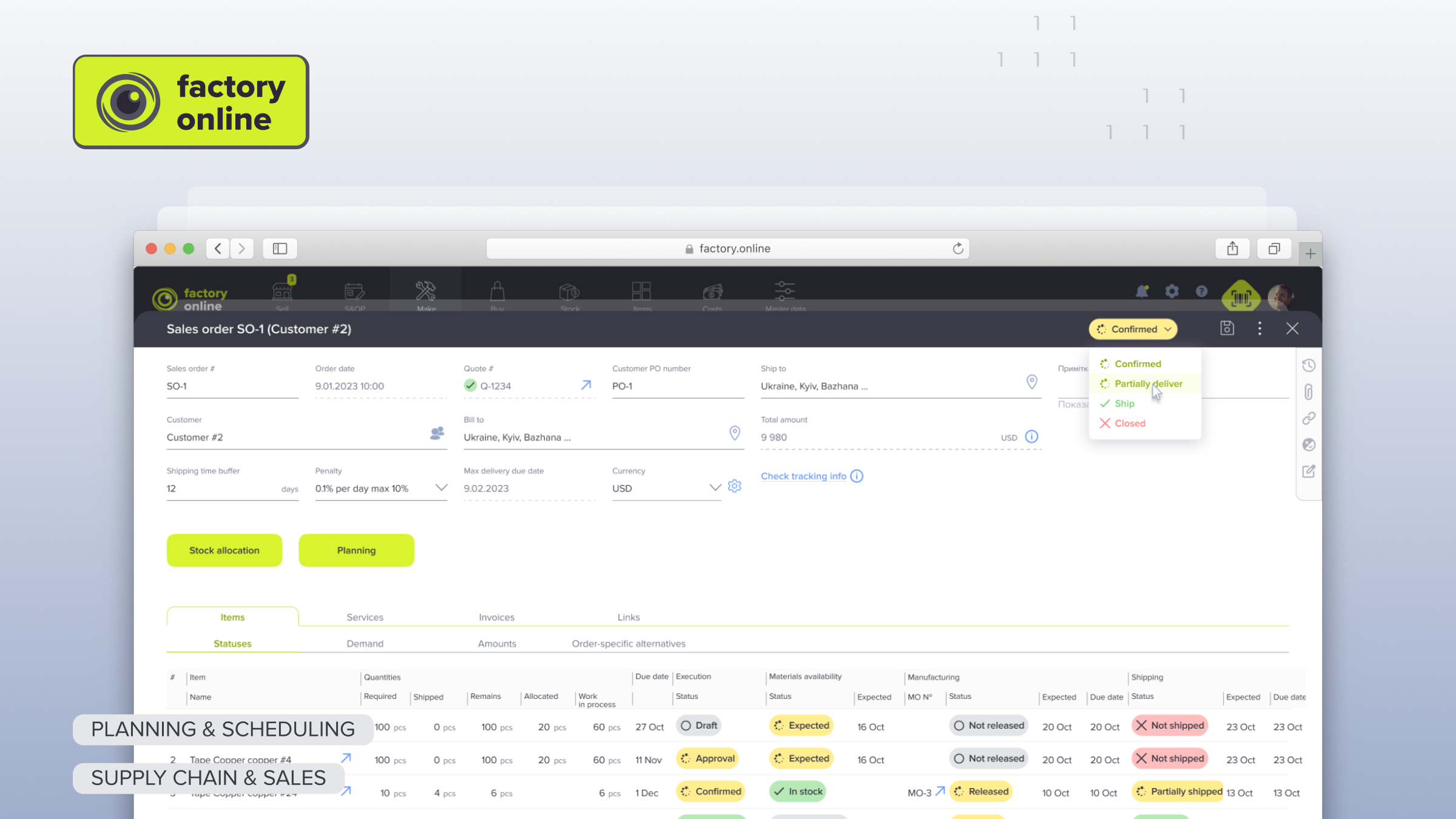
Within factory.online, order promising is directly linked to the actual physics of your cable plant. The platform moves beyond simplistic lead-time rules by running real-time "what-if" simulations the moment a prospective order is evaluated.
By mapping every cable construction directly against available line capabilities, setup matrices, and existing WIP flows, factory.online provides an instantaneous, transparent view of true delivery feasibility. Sales and planning teams can instantly see whether a requested delivery date is realistic, exact changeover impacts, and what adjustments would be required across the plant to make it happen.
Delivering on time isn't a miracle performed by shop floor supervisors under pressure — it's a structural decision made at the moment of order acceptance. If you are ready to eliminate schedule friction and protect your operating margins, book a demo with our team to see constraint-aware planning in action.
