

27 Sep 2026
From Operational Chaos to a Unified Enterprise Digital Ecosystem
Discover how factory.online connects sales, procurement, inventory, MES, and cost accounting into a unified, event-driven digital manufacturing ecosystem.
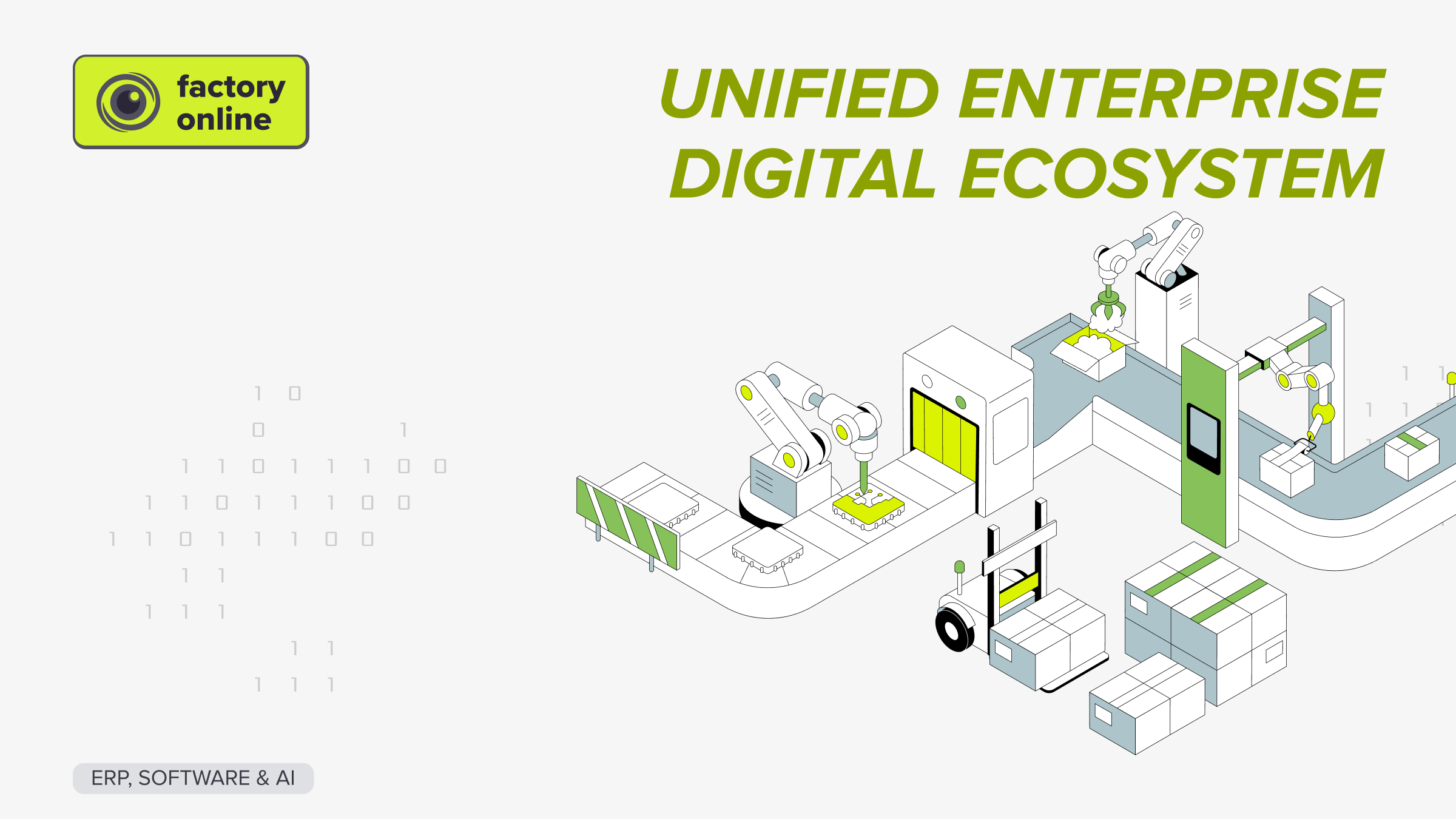
In modern industrial engineering and operations management, the efficiency of a manufacturing system is determined not only by the throughput of individual production units, but by the degree of data connectivity between them. The manufacturing lifecycle of any complex product comprises dozens of interdependent steps. However, many enterprises face a fundamental structural challenge: information fragmentation (the "silo effect"), where each department operates within its own isolated data repository.
When sales, procurement, warehouse logistics, and shop-floor execution function in disconnected spreadsheets, localized databases, or paper-based documentation, the integrity of the information chain breaks down at the handoffs between departments. This leads to latency, duplicated data entry, a high probability of human error, and a loss of real-time end-to-end visibility.
To eliminate these structural bottlenecks, the factory.online platform offers a unified information architecture that converts fragmented business functions into a deterministic, end-to-end controlled system.
1. Architecture of the End-to-End Value Chain
Rather than relying on functionally isolated software solutions, factory.online consolidates all stages of order fulfillment into a single cloud ecosystem. This ensures full synergy across commercial, technological, material, and financial workflows within the enterprise.
End-to-end functionality is delivered through an interconnected matrix of specialized modules:
• Commercial Management (Sales)
Handles initial client demand registration, commercial proposal generation, invoicing, and contract management. A customer order acts as the primary trigger initiating the entire downstream planning and fulfillment pipeline.
• Master Data Management (MDM)
Serves as the centralized core system registry, eliminating discrepancies in item nomenclature, units of measure, commodity groups, counterparty parameters, and organizational structures. It acts as the single source of truth (SSOT) across all modules.
• Engineering & Bill of Materials (BOM)
Maintains detailed multi-level material specifications (BOM), process routing charts, operation sequences, labor standards, as well as packaging, container, and handling specifications.
• Procurement Management
Automates vendor management, generates purchase orders based on calculated net material requirements, performs incoming quality inspection, and monitors supplier lead-time compliance.
• Warehouse & Inventory Control
Provides real-time batch-, lot-, and bin-level inventory tracking. It records all internal material transfers, inter-shop movements, order-specific stock reservations, and automated backflushing/consumption accounting.
• Manufacturing Execution & Planning (MES/MPS)
Formulates the Master Production Schedule (MPS), generates and distributes shift-level work orders to workstations, logs actual output of intermediate and finished goods, and tracks scrap and rework.
• Cost Accounting
Executes precise actual cost roll-ups for every manufactured unit based on real-time consumption of raw materials, energy, direct labor, and allocated overhead costs.
• Business Intelligence & Reporting (BI)
Provides cross-functional key performance indicator (KPI) monitoring, plan-vs-actual variance analysis, and real-time financial and operational control.
2. Event-Driven Architecture and Data Synchronization
A key technological advantage of the factory.online end-to-end ecosystem is its event-driven data synchronization. Any transaction or status update within one module instantly triggers a chain reaction of automated recalculations across all connected domain logic:
Customer Order⟶Automated MRP Engine⟶Purchase Requisition / Inventory Reservation⟶Shop-Floor Work Scheduling
- Demand Explosion: Upon order confirmation, the system automatically expands its multi-level BOM and reconciles requirements against available on-hand inventory and incoming purchase orders.
- Automated Task Generation: For component deficits, purchase requisitions are instantly generated for procurement, while production orders and routing instructions are issued directly to the shop floor for manufactured items.
- Prevention of Stockouts and Excess Inventory: Real-time responsiveness prevents line shutdowns caused by missing critical components while eliminating tied-up working capital from buffer stock accumulation.
3. Risk Mitigation and Economic Impact
Transitioning from fragmented management to the integrated digital architecture of factory.online yields measurable operational and financial returns:
- Elimination of Data Silos: Replaces manual data transfer between disparate sheets and systems, reducing human error rates to zero.
- Lead Time Reduction: Instant propagation of management signals from sales down to shop-floor execution significantly compresses the overall order fulfillment cycle.
- Cost Accounting Precision: Complete visibility into cost structures at every intermediate stage enables early identification of operational waste and optimizes product pricing strategies.
- Full Product Traceability: End-to-end lot genealogy guarantees complete backward and forward traceability—from raw material supplier certificates down to the finished shipped product.
Conclusion
Modern manufacturing enterprises can no longer afford the inefficiency of disconnected operational tools. To maintain competitiveness, agility, and high operating margins, full visibility across the entire value chain is essential.
The factory.online platform unifies complex, multi-stage production and logistical workflows into a single, high-precision, predictable digital ecosystem—delivering total operational control across every level of management.
