

6 Oct 2026
Planned Maintenance: Where 12 Hours of the Production Plan Disappear
The machine has 80 hours on its calendar, but only 68 for production. A worked example shows why service windows must be visible before delivery dates are promised.
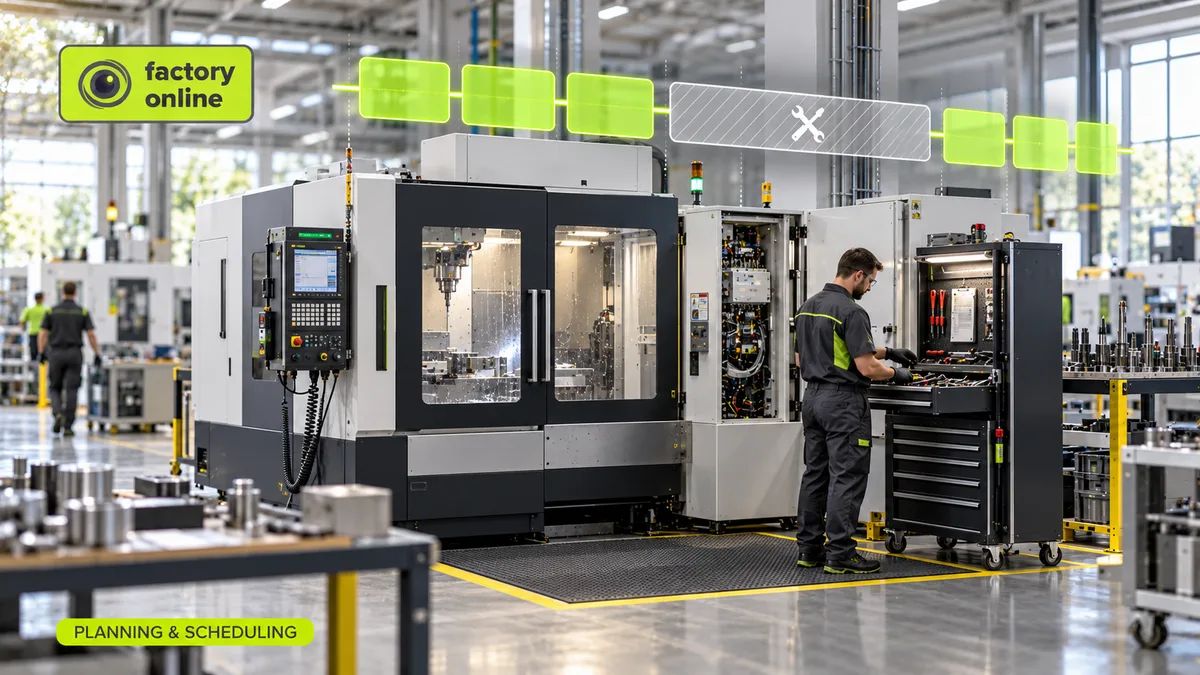
On Monday, the planner sees 80 machine hours for the week. Orders need 74. Six hours remain, so sales confirms a Friday delivery.
On Wednesday, the service crew arrives. Maintenance was agreed two weeks ago, but it stayed in the mechanic's calendar. In the production schedule, the machine was available throughout.
The orders now exceed the week's capacity. The conflict could have been found before the delivery promise.
Planned maintenance must change the resource's available time in the production plan. A known shutdown belongs alongside shifts, changeovers and operation sequences.
80 hours on the calendar, 68 hours for production
Consider a hypothetical machine working five days with two eight-hour shifts per day. Its calendar contains 80 hours. For simplicity, assume breaks have already been accounted for.
Wednesday's maintenance takes eight hours. Inspection and return to production require another two. Production changeovers across the week take two hours.
Available processing time is 80 − 8 − 2 − 2 = 68 hours.
The orders require 74 hours of processing. Those 74 hours exclude changeovers, which we have already deducted separately. The shortage is six hours.
That calculation is enough to reject an unrealistic weekly plan. It still does not identify which order will be late. Operation timing determines that.
The shutdown's position in the week matters
Hypothetical order A needs six hours on this machine and four hours in packing. Both departments work 06:00–22:00. Assume immediate transfer and no packing queue.
Maintenance and inspection occupy Wednesday 06:00–16:00. Starting A afterwards finishes machining at 22:00. Packing starts Thursday at 06:00 and finishes at 10:00. A Wednesday 18:00 dispatch is impossible.
Machining A on Tuesday 12:00–18:00 lets packing finish at 22:00 that day. Wednesday's delivery remains feasible, provided materials are ready and other orders do not conflict.
This is the distinction between capacity checks and production scheduling: one finds missing hours; the other identifies the affected delivery.
What to check before agreeing a service window
The planner and maintenance team need shared information:
- The exact resource and its unavailable interval. Stopping one machine does not always stop its entire work centre.
- Time to return to acceptable output. Inspection, adjustment and trial production can extend the window.
- Orders that must pass through the resource before imminent deliveries.
- Alternative resources with verified process approvals.
- Material readiness and downstream availability in the proposed sequence.
Check the resource that limits plant output especially carefully. Its shutdown can change the whole flow.
Moving maintenance requires a separate decision
When hours are missing, postponing service looks easy. Equipment condition, maintenance rules and safety requirements determine whether postponement is acceptable. The planner must agree it with the responsible specialists.
Compare other options first: complete the critical operation earlier, use an approved alternative resource or agree another delivery date. An extra shift helps only when the equipment, people and materials are available at the required time.
Keep the agreement current
Once the shutdown is agreed, enter it in the resource calendar, check dependent orders and assign responsibility for updating its expected finish. Assess the remaining operations immediately if maintenance overruns.
Compare the planned window with the actual return to production. Repeated differences help improve the next estimate.
How this connects to factory.online
factory.online production schedules use resource calendars and available capacity. In this situation, represent equipment unavailability in planning data and check dependent operations on the Gantt chart. Planning scenarios help compare alternative sequences.
If service work still lives separately from production scheduling, book a factory.online demo. Bring the maintenance calendar and several orders with approaching delivery dates to test what a realistic plan should look like.
