

1 Oct 2026
Production Schedule Templates vs Scheduling Software: When to Switch
Excel templates work — until they do not. The specific breaking points that tell you a spreadsheet schedule has run out of road, and what changes when you move to real scheduling software.
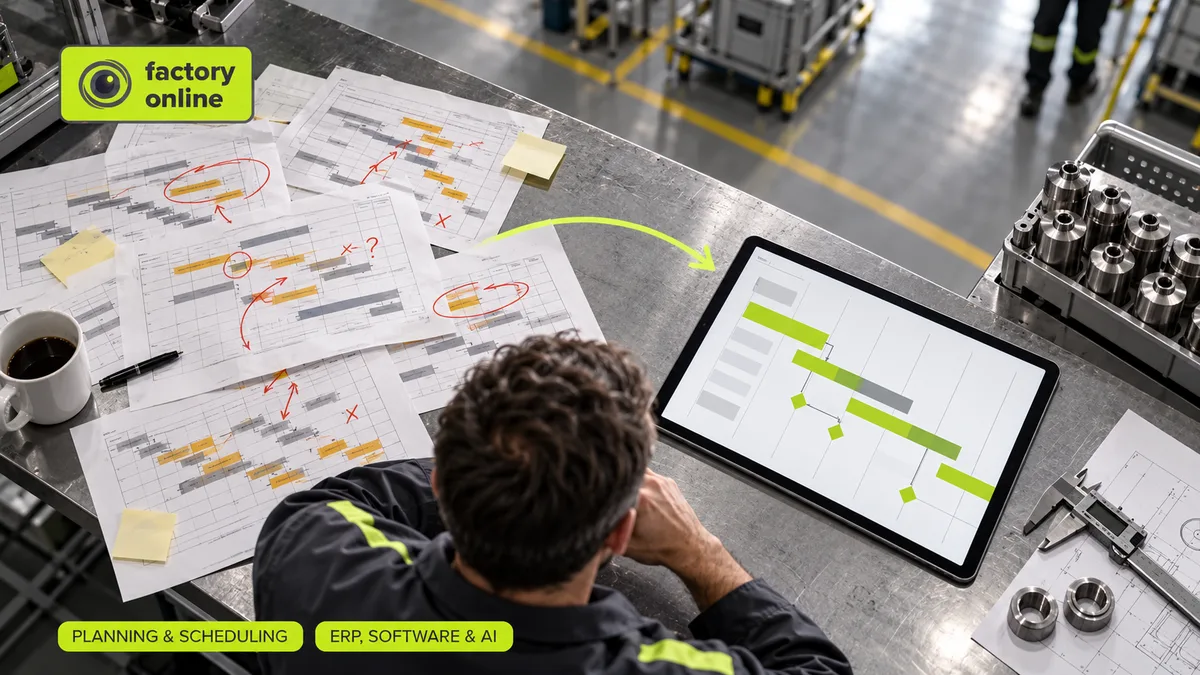
Almost every manufacturer schedules in Excel at some point, and for a while it works. A production schedule template is free, familiar, and flexible. The question is never "is Excel bad?" — it is "have we passed the point where it costs more than it saves?"
Here are the breaking points, in the order they usually appear.
Breaking point 1: One change means rebuilding everything
A machine goes down at 9:00. In a template, every downstream job on that machine — and every job waiting on those jobs — must be found and moved by hand. With five machines and fifty jobs this is an hour of careful dragging. With fifteen machines it is simply not done, and the floor improvises.
Scheduling software resequences the affected jobs automatically. The planner's job changes from rebuilding the plan to reviewing it.
Breaking point 2: The template does not know your capacity
A spreadsheet will happily place three jobs on one machine at the same time. It has no concept of shifts, maintenance windows or alternative work centres — all of that lives in the planner's head. Which means the schedule is only as good as one person's memory, and disappears when they take a vacation.
Breaking point 3: Version chaos
Schedule_v7_FINAL_rev2.xlsx. The office has one version, the floor printed another yesterday, sales is quoting from a third. When the schedule is a file, there is never one truth. When it is a system, everyone looks at the same live plan.
Breaking point 4: Changeovers are invisible
Templates show what runs, not what it costs to switch. The difference between a good and bad sequence — often hours of setup per week — stays hidden because the spreadsheet cannot see changeover matrices.
Breaking point 5: Nobody can answer "when will it be ready?"
The customer-facing cost. Without finite-capacity scheduling, promise dates are estimates built on estimates. Sales pads dates, production expedites anyway, and the plant pays for both.
When the template is still fine
To be fair: one work centre, a handful of products, stable demand, one person who owns the plan — a template serves this plant well. The switch makes sense when two or more breaking points above are your daily reality.
What actually changes after the switch
Not "digital transformation" — three concrete things: replanning takes minutes instead of mornings, promise dates become defensible, and the schedule survives the planner's day off. We covered the full process in how to plan production schedules and the selection criteria in scheduling software for small manufacturers.
