
How the Cable Industry Loses Profit at the Planning Stage — and Why It Becomes a Systemic Business Problem

The cable industry operates in a highly variable environment: multiple product types, custom orders, raw material constraints, and constantly changing demand.
On the surface, production may look fully loaded and stable. But in reality, control is often lost at the planning stage.
And this is exactly where a significant share of losses originates.
The Core Problem: Plan vs. Reality Gap
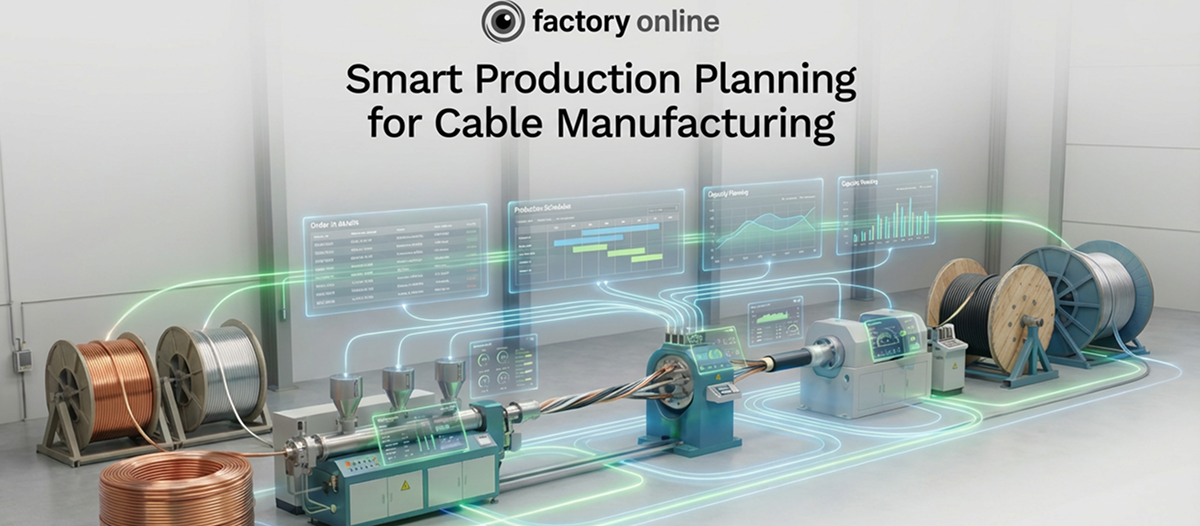
Cable production is a multi-stage process:
drawing → stranding → insulation → sheathing → winding
Each stage depends on the previous one, and any deviation immediately affects the entire chain.
In practice, this leads to:
- production plans that do not reflect real equipment constraints
- changeovers between cable types that disrupt the flow
- orders constantly being rescheduled manually
- bottlenecks shifting from one stage to another
As a result, planning and execution become disconnected, and management turns into constant firefighting.
What Scales Is Not Efficiency — but Complexity
Many companies grow in volume, but not in profitability.
Equipment utilization increases, but so does operational complexity.
The main losses are formed within the so-called “hidden production”:
waiting between operations, excessive changeovers, flow disruptions, and lack of synchronization between departments.
These factors are rarely visible in planning systems, yet they directly impact lead times and costs every day.
WIP as a Hidden Warehouse
Work-in-progress plays a critical role.
Semi-finished products accumulate between stages, occupy space, tie up working capital, and create an illusion of productivity.
In reality, the business is operating — but a significant portion of money is simply “stuck” inside the process.
The Key to Efficiency: Synchronization
In the cable industry, the main growth driver is not additional capacity — it is synchronization.
Planning must reflect not only demand, but also real production constraints, material availability, and process logic.
This is exactly what factory.online enables:
- demand-driven production planning
- consideration of real production constraints
- synchronization of orders, materials, and capacity
- fast plan adjustments in response to changes
Business Impact
This approach allows companies to:
- reduce production cycle time
- minimize WIP
- improve on-time delivery performance
- stabilize production flow
Conclusion
In cable manufacturing, efficiency does not start on the shop floor.
It starts with planning.
And without digital tools, achieving this becomes increasingly difficult.
.svg)
.svg)
.svg)
.svg)